
The purpose of PART 2 is to help you distinguish between the two types of hunger. If you can make this distinction, it will enable you to pause before you start eating and ask: “Why do I want/need to eat something now?”
You see, we eat or drink something because we want to satisfy a need. If the need is important for survival (the same goes for sleep, or to seek shelter against the cold), it must be satisfied. But sometimes the act of eating or sleeping is not motivated by a PHYSICAL need – instead, it may be an EMPOTIONAL need that seeks to be satisfied.
In PART 1 you already discovered your triggers for emotional eating. But just knowing it will not automatically prevent you to act differently on the impulse of wanting to eat. In order to change our behaviour, it is not enough to KNOW about it – we must DO something about it.
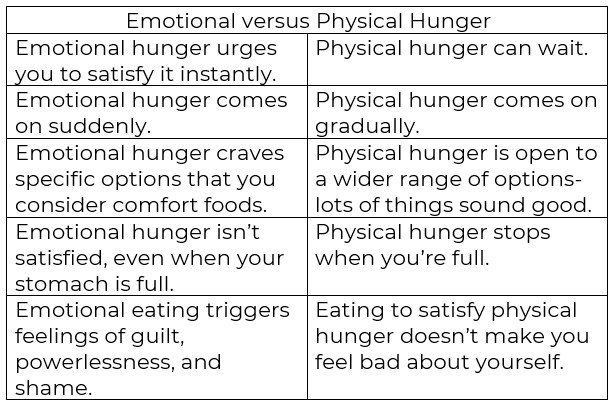
So, the first important step to overcome emotional eating, is to distinguish between EMOTIONAL hunger and PHYSICAL hunger. Let us look at the differences in the following table:
TABLE:
Now that you can distinguish between a physical need versus an emotional need to eat something, you can use your “moment of choice” before you act. Let me explain this:
Stephen Covey (the author of the well-known bestseller of “Seven Habits of Highly Effective People”) said that there is one important difference between animals and human beings. Animals act instinctively on an impulse, and do not “think” before they act. Human beings, on the other hand, has what he calls “a moment of choice” – we can think about the consequence of our action before we act!
And now it should be clear how to use this powerful ability to think before we act, in dealing with emotional eating. (This principle can also be used in dealing with many other impulses.)
All you have to do is to put off eating for five minutes. If five minutes seems unreachable, try one minute. Ask yourself the following questions:
Now is the time for you to “digest” this! Practice to distinguish between physical and emotional hunger every time you feel the urge to eat, or to open the fridge. Do this by asking yourself the four questions above. Or you can make it even stronger, and put up a notice on your fridge and your food/snacks cabinet:
STOP – ASK – ACT!
In PART 3 to follow, we will unpack the alternatives to emotional eating, as well as practical tips on how to manage the effects of your emotions on your eating behaviour. Good luck on your journey to a happier, healthier you!